

Review written by Mike McNamee in the Sep 25 issues of Professional Imagemaker magazine.
This is a 100% cotton rag-based media with a zero OBA coating and a weight of 310gsm. The surface is a light satin finish. It is part of the Heritage Range, which we tested in November 2022. At the time, the Baryta Rag 310 performed well, but some of the testing was marred by scum dotting, a software glitch problem that has nothing to do with either the printer or the paper. For this reason, we decided to re-run the tests. Our ambition was to see if we could inch the excellent performance of Baryta Rag 310 to an even higher level.
The previous tests were conducted using a variety of printer media settings and both the so-called V2 and V4 profile types (mainly attempts to eliminate scum dotting). The settings were Premium SemiMatt Photo Paper 260, Premium SemiGloss Photo Paper 250, Premium Lustre Photo Paper 260. The media setting ‘Baryta’ was newly available at the time. We also used the Epson 4900 printer, which used a similar ink set, although the PS000 has a claimed improved Pk ink due to an enhanced particle coating.
The media base tone
The media has zero OBA and is optically dead in the UV booth. It is two Lab points yellow, giving it a slightly creamy warm tone, though it is very close to neutral. Although the surface looks both flat and matt in the unprinted state, the ink brings out a lovely, fine lustre finish which also seems quite durable. The Whiteness parameters are shown in the table below.
Colour Audit
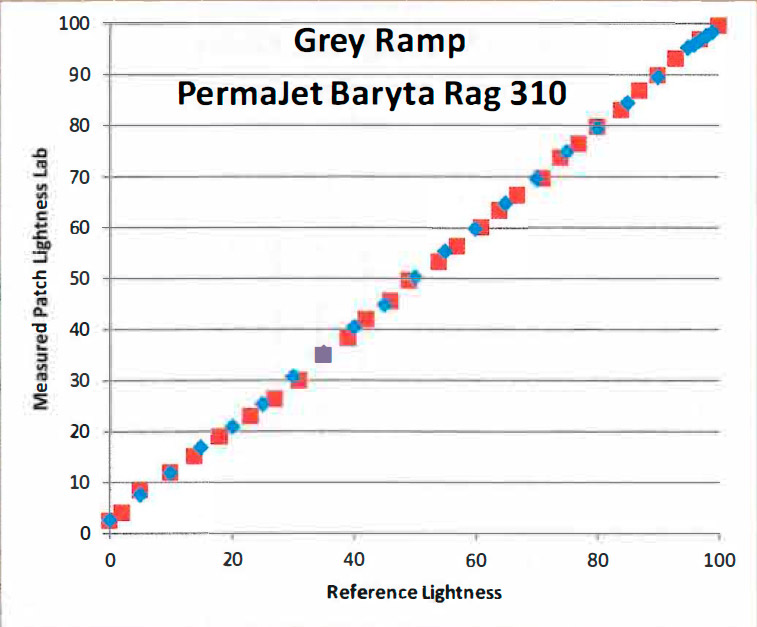
The collated statistics are shown in the table below. They are an excellent data set, in many cases best-in-class. The average error was just 1.57△Eoo for the 216 patch set. The Macbeth CC24 patch set (which is more forgiving, having a slightly lower contrast) delivers an error of 1.11△E00 that is, right on the limit of human detection. It placed the 50% Lightness patch on 50.17% and the deepest shadow recorded was 2.64%, a Dmax of 2.48, and a residual error of 1.68△Eoo. The linearity of the greyscale fitted with a statistical accuracy of 99.97% (R² value) and overall the error along the greyscale was good enough for it to even be a useful reference standard.
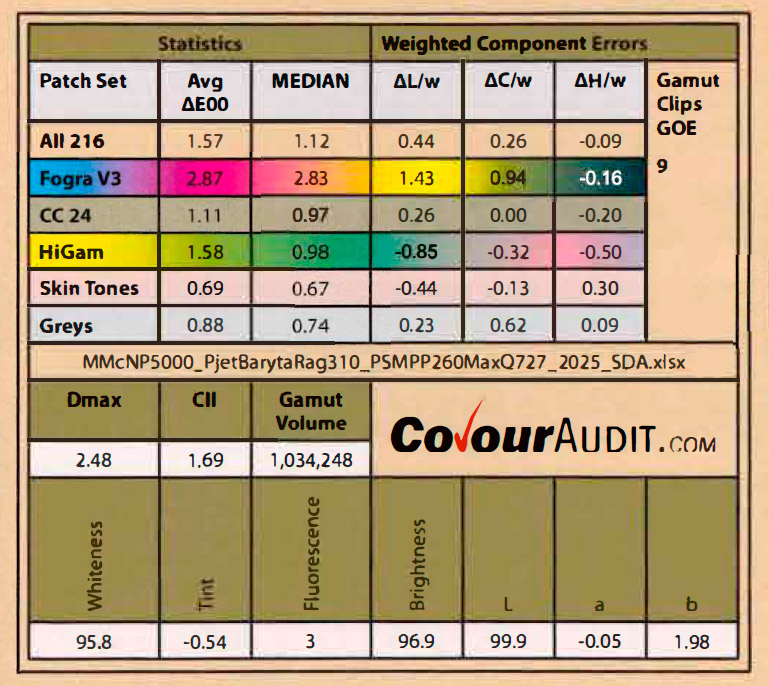
The gamut volume was over the 1 million mark and just nine Pantones of the GOE set were clipped – all but one of the clipped patches have errors of less than 2△Eoo. Of the nine clipped Pantones seven were in the red part of the gamut as illustrated by the screen grab below. There was a single clipped Pantone from the purple-blue portion of the Pantone gamut. In the screenshot, the aim and clipped values are displayed on the diagonal of the square patches and may be barely visible on the printed page.
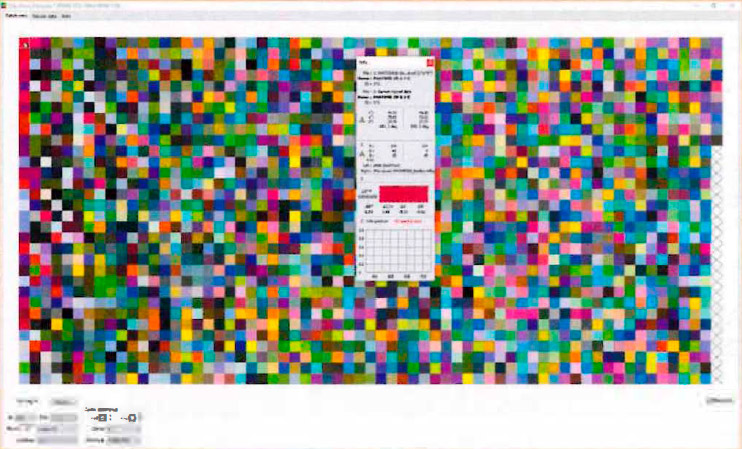
The worst error was cyan at 5.32△E00 but 90% of the error related to the Lightness channel which was 6% too dark. The (HDR) printer’s ink set always struggles with this tone. Overall then this was a superb set of results.
Monochrome via the ABW
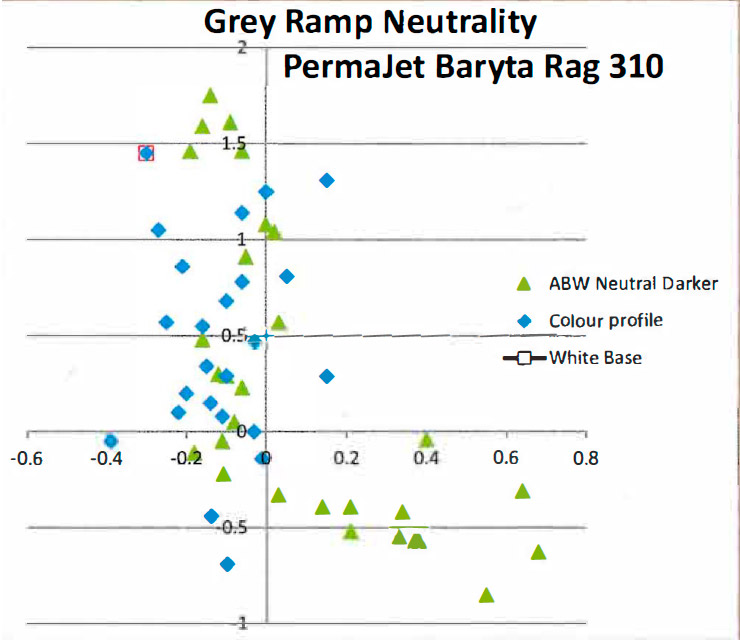
Although our colour profile delivered a spectacularly good monochrome reproduction, others may still prefer to use the Epson Advanced Black and White (ABW) driver. This was tested using the PLPP260 media setting with tone settings of Neutral and Darker. This delivered a slightly higher Dmax at 2.63 (the usual outcome when changing to the ABW driver). The metamerism CII rose slightly to 2.51 (another expected outcome) and the 50% aim patch tone delivered 49.4%. Thus, the setting of Neutral Dark should be the starting baseline for mono printing. Users may prefer and employ a darker or lighter tone setting based purely on visual judgement. The linearity of the tone ramp was close to that of the colour profiled print and the two are plotted on the same graph below.
We also plotted the tone neutrality of both grey ramps. Although there are discrete differences in the graph, for all practical purposes they can be considered identical. The residual colour bias of the greys will be undetectable.
Generic profile testing
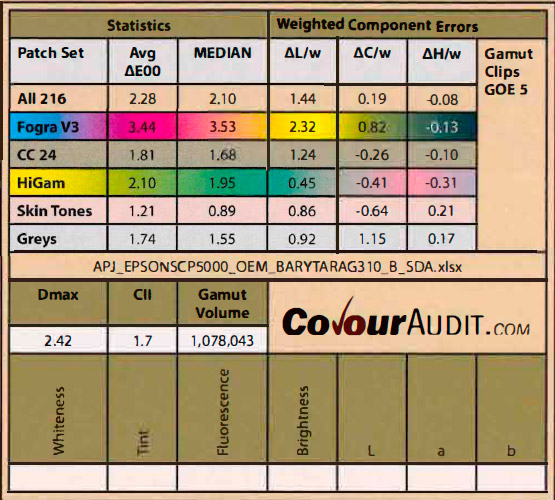
There are users who wish to use only the generic profiles made available by the paper manufacturers. To this end, we downloaded the PermaJet icc profile for Rag Baryta and used that to make a print for audit testing. The result was excellent for a generic profile, a testament to both the printer repeatability and the PermaJet profiling. The average error was 2.28△Eoo, on a par with some of our bespoke profiles but not quite at the standard of our latest effort. The gamut volume was actually slightly higher and the number of Pantone GOE clips dropped to just 5.
The data are tabulated and overall, this excellent generic profile is perfectly acceptable for all high-quality printing applications.
Printing without colour management
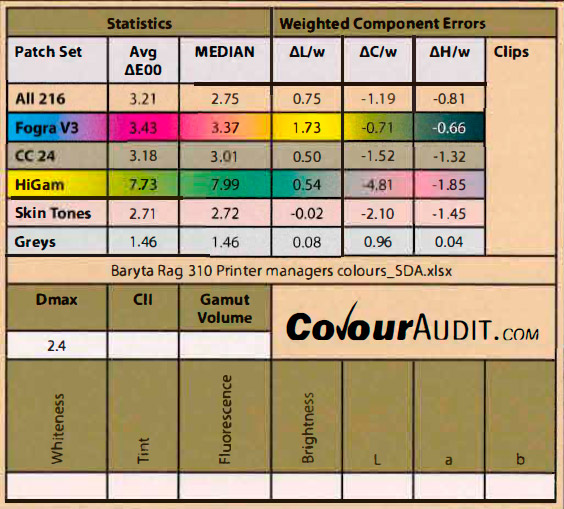
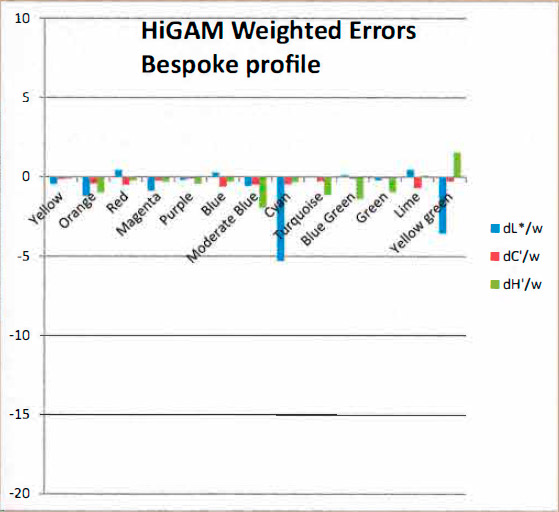
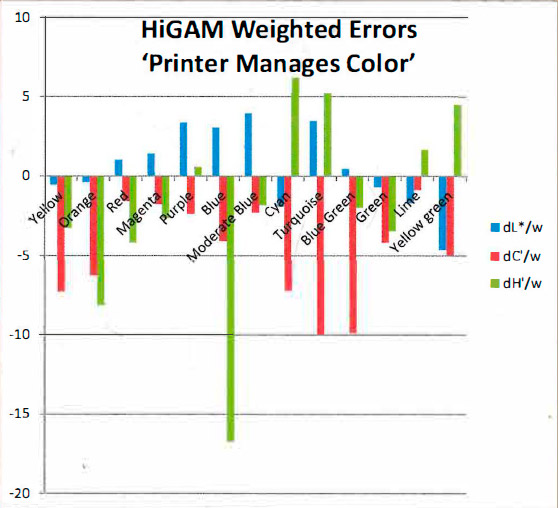
Some users baulk at the complexity of using ice profiles and so for completeness, we ran an audit on Rag Baryta using ‘Printer Manages Color’. This turns off control and hands it over to the printer driver. In the most recent driver there is a media setting called Baryta so that is what we used. The errors rose to an average of 3.21△Eoo. Within that the HiGAM errors took a bit of a hit, rising from 1.58△Eoo for our bespoke profile to 7.73△Eoo for the un-colour managed print. Both the chroma and hue we compromised with the data points shifted significantly inboard ie less saturated. The largest HiGAM error was a whopping 17.5△Eoo.
This is not a workflow we would recommend and the pair of histograms below illustrates the loss of colour accuracy; they barely fit on the same graph so we have shown two sets each on the same axis. Note how large the histogram bars are on the right (which is bad) and that the longer bars involve both hue and saturation, something that does not happen with good profiles, which usually compromise just the Luminance channel.
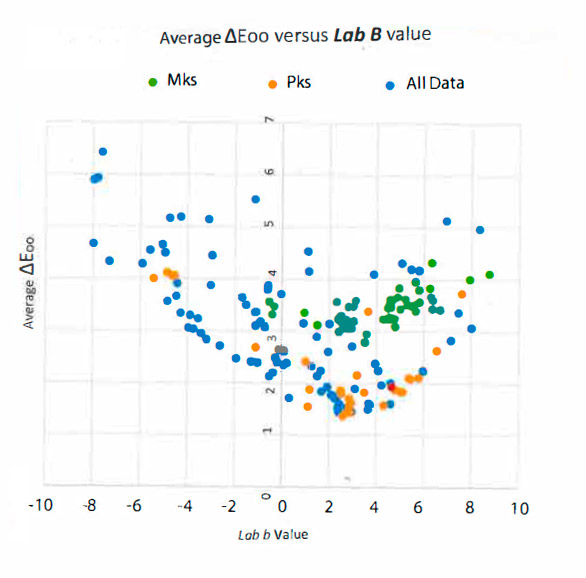
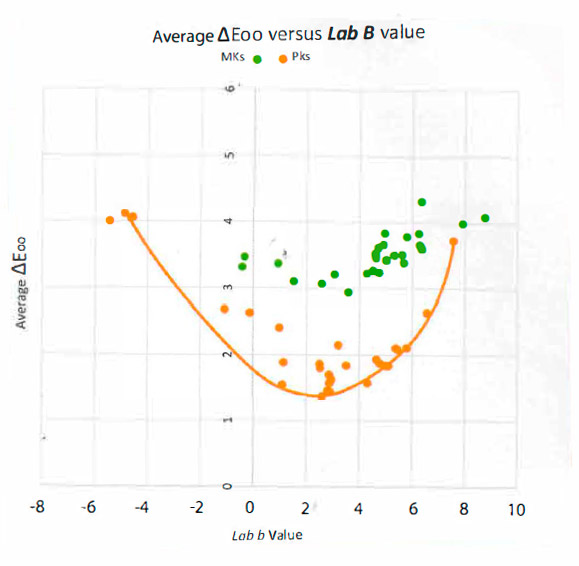
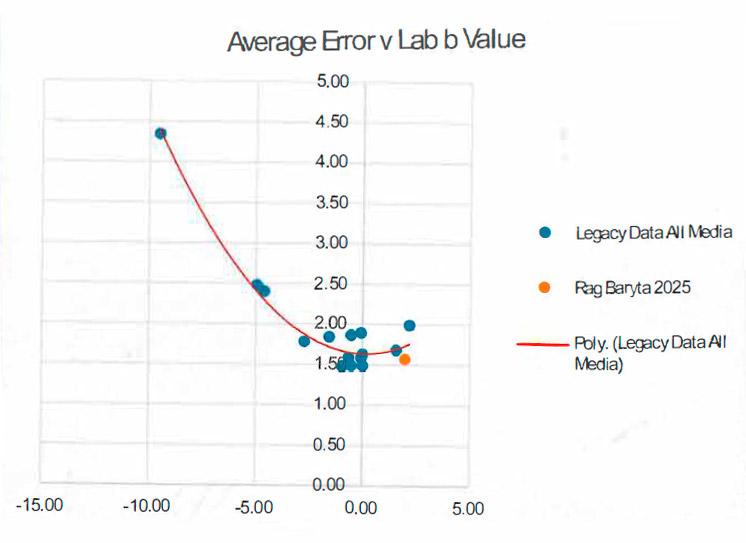
The graphs below illustrate the way that we have been able to refine the statistics in this latest round of analysis. The first graph is a mass of data with no recognisable relationships until we separate the print data using either the Pk or Mk inksets (which translate roughly into matt art papers for the Mk and gloss/lustre media for the Pk). This is further refined in graph two, where the data for assorted printers and surfaces are eliminated. Finally, by taking just the PermaJet baryta range, the graph at the bottom resolves the data and relationship more clearly having eliminated many of the variables. Now we have a clear idea of what to expect from a baryta surface printed from the SC5000 and its relationship to the Lab b value of the base paper and in turn the level of OBA used in the coating.
Overall
This is a really top-class media which can be recommended without a single reservation. It makes a perfect monochrome choice and the colour accuracy is such that a print may be relied on to be a near-perfect representation of the image file.