


In December 2022, professional photographer and PermaJet Brand Ambassador Michael O’Sullivan had a serious health scare that forced him to stop and take stock of his life and his photography. It was the start of a journey that would take him back to Kenya, and face to face with a Super Tusker.
For years, his professional work and client deadlines had taken priority. His own photographic projects, including his long-planned return to Kenya, were repeatedly pushed further down the list.
Lying in hospital, Michael made himself a promise: when life and work were back on track, he would make time for the personal projects he had neglected for too long.
At the top of that list was Kenya.
After years of planning, Michael finally made the return trip, photographing the wildlife, landscapes, people and conservation stories he had wanted to capture for so long. Among the hundreds of thousands of images taken during the project, he was also looking for something very specific: photographs that could stand alone as fine art prints.
“Images that look beautiful, and that could stand alone as a printed image. Images that would evoke an emotional response, or evoke a sense of a time, a place, a personality,” Michael explains.
Now back home, Michael has begun printing the first of those images – using PermaJet paper.
For him, seeing these photographs become physical prints is about much more than producing a finished photograph. Holding the image in his hands makes the achievement tangible.
“To me, nothing has ever reinforced the realness of a photographic image more than the emotional and physical sensation of holding the print in my hand. It’s visceral. It’s engaging. It’s real.”
The first prints from his Kenya project represent a milestone: proof that a promise made almost four years ago has finally been kept.
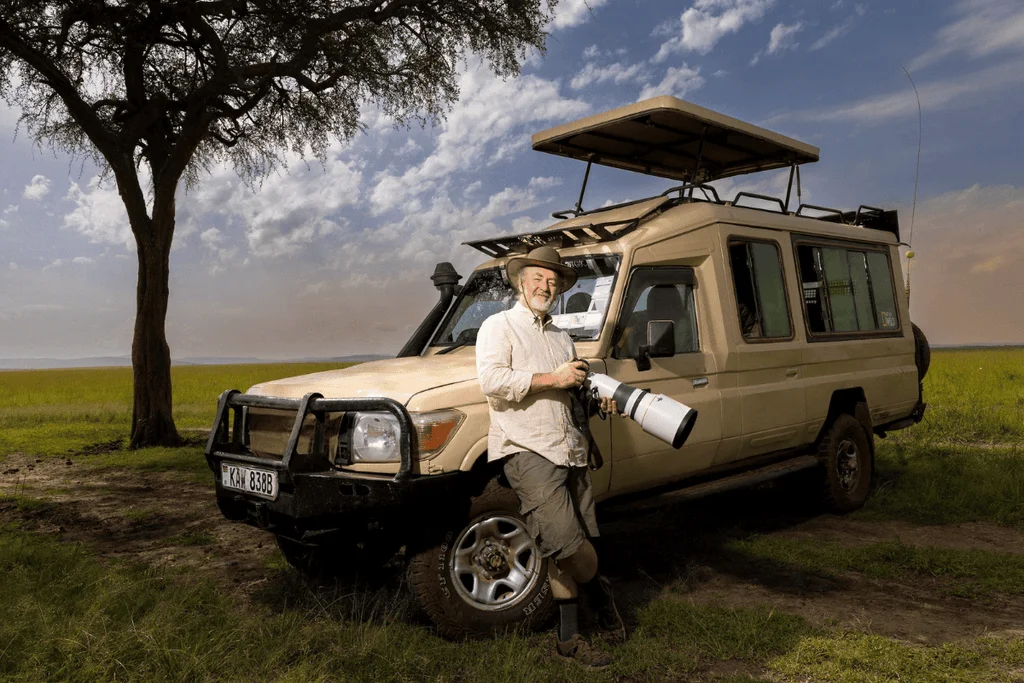
Meeting IR2: the story behind the first print
We caught up with Michael to find out which image made the cut as his first Kenya print, the story behind it, and why he chose to print it on PermaJet paper.
Q. Which image did you choose to become your first Kenya print?
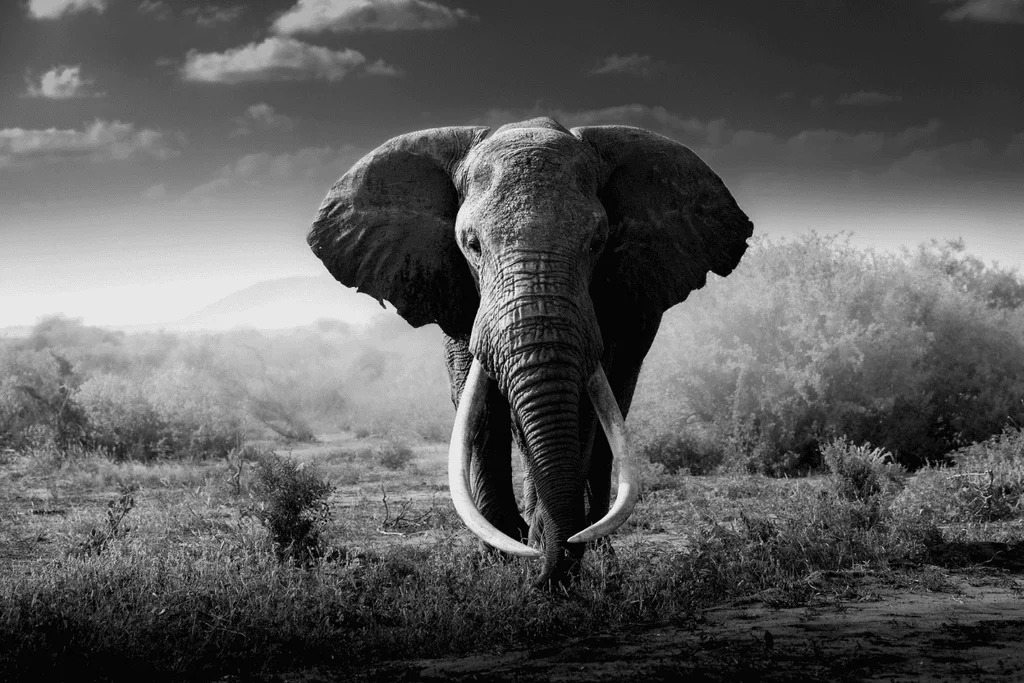
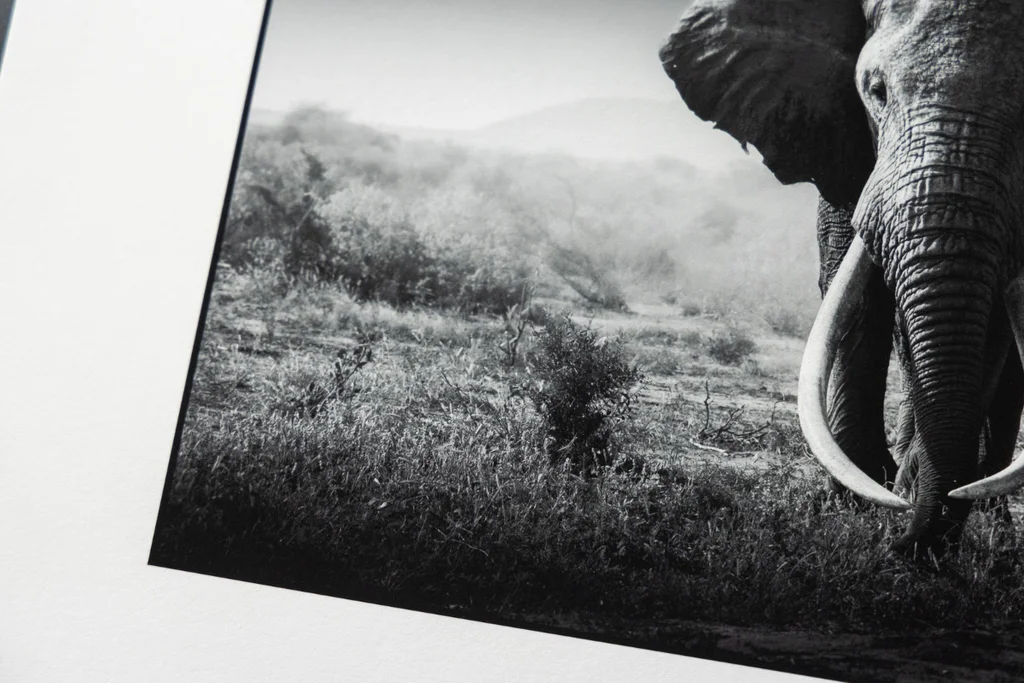
The image I’ve selected is a monochrome image of the Super Tusker known as “IR2”.
Q. For anyone who hasn’t heard the term, what is a Super Tusker?
Super Tuskers are extremely rare individuals who carry the genes for huge tusks. They have been almost wiped out by generations of ivory poaching and trophy hunting. According to Tsavo Trust, there are only 12 known to remain in Tsavo and 10 in Amboseli, with as few as 30 in the world. Some estimate there might be 50 or more, but those numbers are speculative.
Q. Where were you, and what was happening when you took the photograph?
We spent some time driving around Tsavo East looking for some particular elephants, specifically any of the Super Tuskers that call Tsavo home. We stayed around an area near the Nairobi–Mombasa Highway at the edge of the park, as we had spotted an elephant with huge tusks disappearing into the bush.
After some searching, we caught sight of him again. It turned out to be IR2, a known Super Tusker who is notoriously elusive.
Q. How did you set up the shot?
I watched his movements with our guide, and we adjusted our viewpoint. We picked out an area of background in the direction he was moving, hoping he would move into it and take up a very specific position as he passed close by. I also wanted him to face towards me with his ears flared. Not a lot to ask, really!
As it happens, he obliged, shaking sods and throwing dust into the air, and we only needed to slightly adjust our position to match his actual movements.
Q. You’ve kept a lot of the landscape in the frame. Why was that important?
It was really important to me to include the environment in the shot. I wanted a lot of the images from across Kenya in this project to say something about the environment these amazing creatures inhabit. I wanted this shot to scream “Tsavo!”
The current trend is to shoot elephant portraits from ground level. It’s a valid approach, especially for adding drama or managing a busy background, but I think it can be a bit fatiguing if it’s every image. I try to use that approach sparingly, and only when it suits the narrative.
Q. Did you know straight away that you’d get the shot?
I took a variety of images of him that I was happy with, but when the shutter clicked on this one, I knew it was the image I had in my head. I just really hoped I’d got it right and hadn’t messed up the focus or made some other technical blunder!
Why IR2 had to be printed
Q. Why did you choose this image to become a fine art print?
This image represents one of the primary goals I set for myself: to photograph some of the Super Tuskers, and hopefully do them justice while saying something about them. Elephants are individuals, with very distinct personalities and temperaments. Very little is known of IR2’s temperament, but my experience of meeting him is reflected very clearly in this image.
Q. What was it like being in his presence?
We met IR2 while he was in musth, a time when even the friendliest elephants can be unpredictable and possibly even dangerous, so we had to be extremely careful. It was important to give him lots of space and let him move wherever he wanted. We stayed calm, made sure we wouldn’t intrude on his peace, and kept plenty of room behind us to leave if we needed to.
He checked us out, watched us from a safe distance and sniffed us out. Then he simply went back to his grazing and dusting, with slow, deliberate, calm movements, even coming closer to us as he grazed. For an elephant clearly in musth, of unknown temperament, and as huge and powerful as he is, he could not have been more calm or tolerant of our presence.
It made me feel very privileged, welcome and overawed.
Q. What do you hope people feel when they look at the print?
For me, this image has all of the calm and tolerance he showed us. I think it also shows the immense awe and respect he commands, surrounded by his territory. We could only stay in his presence because he allowed us to.
I also wanted a sense of timeless nostalgia, or a melancholy pathos, in this image. I see him as one of a few remaining custodians of a legacy that has all but vanished, and that makes me fearful, and sad.
Choosing the paper
Q. Which PermaJet paper did you print it on, and why?
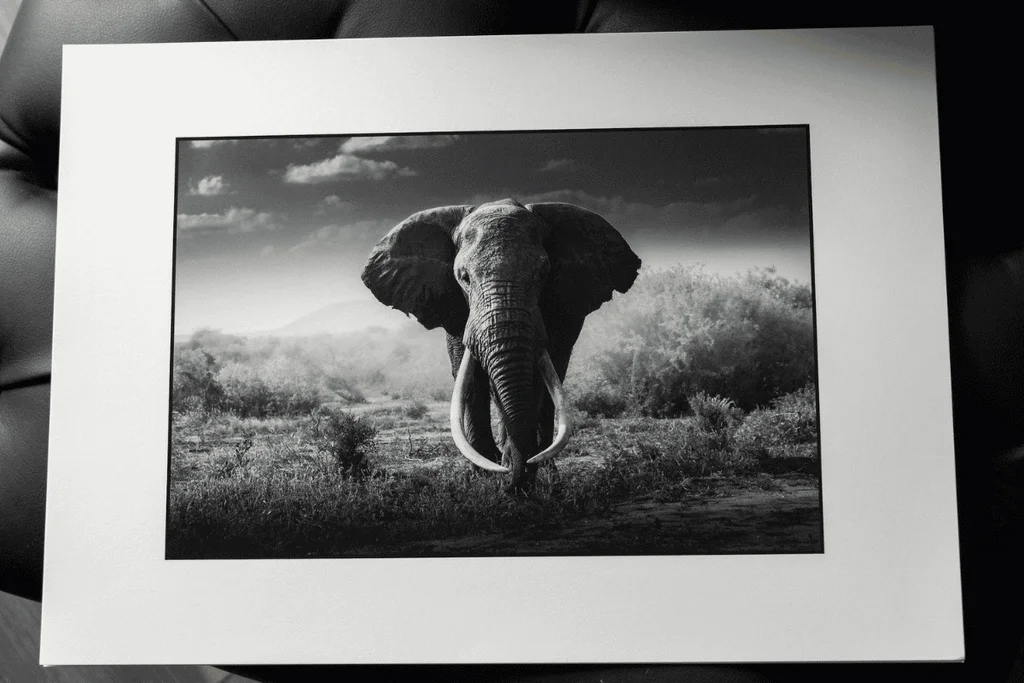
So far I’ve printed this image on Portrait White 285 and on Smooth Rag 310.
For most of my matt prints I gravitate towards Museum Heritage 310 or Portrait Rag 305 for their textures. In this case, though, I figured the smooth surfaces of Portrait White 285 and Smooth Rag 310 would handle the image better. They really show off the crisp contrast between IR2’s ears and the background, while still faithfully reproducing the subtle textures of the vegetation in the softer background.
Q. So which one wins: the bright white or the natural base?
That’s the only decision left: whether I prefer the bright white base of Portrait White 285 or the natural base of Smooth Rag 310 for this image. Honestly, I think they both work really well, and it might come down to where the print will be displayed.
I’m also planning multiple editions of some of these prints, so this image might find permanent homes on both papers, and perhaps some others too.
From screen to print
Q. Did anything surprise you about seeing the image in print compared with on screen?
Yes and no. I knew the print was going to work out. I had prepped the image, and it easily lived up to the image in my head, so I wasn’t surprised that it worked or that I was happy with it.
What did surprise me was how much I preferred the printed version. I think it comes down to the sense of depth a good print always has for me. There’s something about the reflective nature of a print that adds that extra hint of realism and depth.
Much as I love seeing my images come to life in the “digital darkroom”, nothing compares to watching the print of a favourite image emerge from the printer, when it truly comes to life for the first time.
Q. And finally, what does holding that first Kenya print in your hands mean to you, after everything that led up to it?
It’s fantastic. It felt like I had just won something, and in a sense, I had. I’d won a competition against myself.
I had been planning this project for a long time. However much I knew I’d captured the images I set out to capture, and achieved the goals I’d set for myself, it was only when I held the first print in my hand that it was real.
This print represents so much. It’s a tangible representation of the goals I set and achieved. But it’s also like arriving at the destination of a long journey I embarked on many years ago: a journey on which I learned so much, overcame all the challenges life can throw at us along the way, and reached this point with this print in my hand that holds all of that journey.
This print means a lot to me. This print is my trophy!
A promise kept
IR2 is the first of Michael’s Kenya images to make the journey from camera to paper, and it won’t be the last. We’re looking forward to seeing more of the project come to life in print over the coming months.
Want to try the papers Michael used? Explore Portrait White 285 and Smooth Rag 310, or follow Michael to see more from his Kenya project.
The Knowledge Vol 3: The Complete Guide to Art Prints
Paper is one part of a bigger process. Our new ebook, The Knowledge Vol 3: The Complete Guide to Art Prints, covers the rest of it.
Written for artists reproducing and selling their own work, it takes you from capturing the original through to the finished, framed print. Scanning and photographing artwork, getting colour accurate, choosing a printer, print settings step by step, and how to finish, sign and store your editions.
It’s free, and it’s the guide we wish we’d had when we started printing.